
Basement Waterproofing in Philadelphia & Surrounding Areas
Contact Us
Keep Your Basement Dry and Your Foundation Protected
A little water in your basement can be the first sign of a much larger moisture or drainage problem.
Water may enter through a foundation crack during a storm, seep through an older masonry wall, appear where the basement wall meets the floor, or slowly create damp conditions that never seem to completely disappear.
The important question is not simply how do we stop the visible water? It is why is the water getting into the basement in the first place?
Philadelphia Foundation Repair & Waterproofing provides professional basement waterproofing in Philadelphia, PA for leaking basements, wet walls and floors, groundwater intrusion, foundation cracks, drainage problems and recurring moisture.
Our approach begins with identifying the source of the water. From there, we determine whether your property needs targeted leak repair, interior drainage, a sump pump, wall or floor waterproofing, exterior foundation waterproofing, or a combination of solutions. We work with the conditions commonly found throughout Philadelphia, including older masonry basements, row homes, concrete block foundations, stone foundation walls and properties where exterior access can be limited.
Call
(215) 585-2996 for a free basement waterproofing estimate.
What Is Basement Waterproofing?
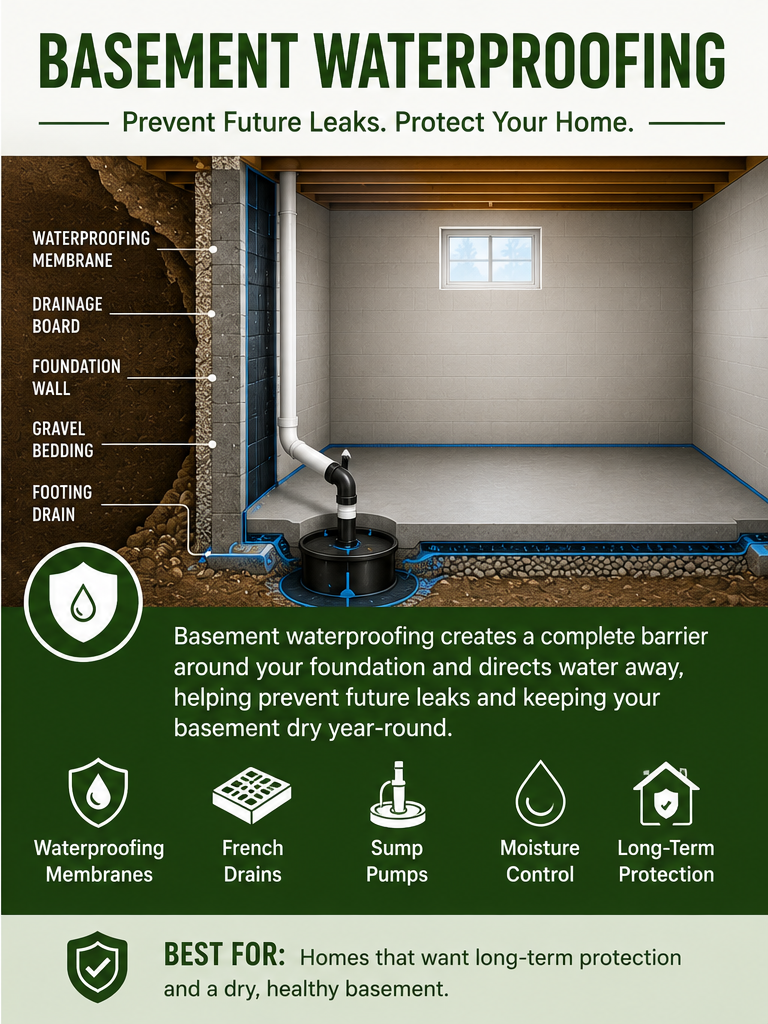
Basement waterproofing is the process of controlling water and moisture around or inside a below grade foundation to help keep the basement dry.
That sounds straightforward, but basement water can come from several different places.
It may originate from:
- Groundwater around the foundation
- Saturated soil after heavy rain
- Foundation cracks
- Porous masonry
- Mortar joints
- Basement wall seepage
- Water beneath the basement floor
- The wall and floor joint
- Poor exterior drainage
- Foundation penetrations
- Basement windows
- Existing drainage failures
That is why there is no single product that constitutes a complete basement waterproofing solution. A properly designed system should address the source, pathway, collection and removal of water.
For one property, that may mean repairing an isolated leaking crack.
For another, it could require an interior perimeter drainage system connected to a sump pump. Another basement may need exterior foundation waterproofing. And some properties have several contributing problems that need to be addressed together.
Why Philadelphia Basements Leak
Philadelphia has a large inventory of older homes, and basement construction can vary considerably from one property to another.
We encounter foundations constructed from:
- Stone
- Brick
- Concrete block
- Poured concrete
- Mixed masonry
- Previously repaired or altered materials
Older foundations can also have decades of patches, coatings, repointing, structural modifications and previous attempts at waterproofing. Then there is the property itself.
Row homes can have neighboring structures directly beside the foundation. Narrow alleys, sidewalks, porches, additions and utilities can make exterior access difficult.
When heavy rain saturates the ground, water can accumulate around and beneath the foundation. If the basement has a vulnerable crack, joint, porous masonry section or drainage deficiency, that moisture can find a pathway inside. Understanding those conditions is important because
Philadelphia basement waterproofing should not be approached as though every house has the same foundation.
Signs Your Basement May Need Waterproofing
You do not need several inches of standing water before investigating a basement moisture problem. Some of the earliest signs are much less dramatic.
Water After Heavy Rain
In Pennsylvania, let alone Philadelphia basements can become really wet primarily due to storms and heavy rain. Water in your basement can indicate groundwater, drainage, cracks or other rain related water intrusion issues that need to be resolved.
Wet Basement Walls
Dampness, staining or visible seepage on foundation walls can indicate moisture moving through cracks, joints or masonry.
Water Along the Basement Perimeter
This is the text area for this paragraph. To change it, simply click here and start typing.
Water Along the Basement Perimeter
Water where the wall meets the floor can indicate a problem involving groundwater and the wall and floor connection.
Wet Basement Floor
Puddles or damp areas without an obvious wall leak can sometimes be associated with water beneath or around the slab.
Foundation Cracks That Leak
A crack may remain dry for weeks and begin leaking once surrounding soil becomes saturated.
White Deposits on Masonry
White mineral deposits can indicate that moisture has been moving through masonry.
Peeling Paint or Coatings
Repeated moisture can cause paint and other wall finishes to bubble, peel or separate.
You Smell Musty Odors
Persistent damp conditions can contribute to the musty smell commonly associated with wet basements.
High Basement Humidity
A basement does not have to contain standing water to have an ongoing moisture problem.
These symptoms help us determine what should be investigated during the inspection.
Our Basement
Waterproofing Solutions
Basement waterproofing is not one service. It is a collection of solutions that address different water entry conditions.
Interior Basement Waterproofing
Interior basement waterproofing manages water from inside the basement.
A system may collect groundwater around the perimeter and direct it toward a sump basin before it spreads across the basement floor.
Interior waterproofing can be especially useful for recurring groundwater problems or properties where exterior excavation is difficult.
- Systems may incorporate:
- Interior perimeter drainage
- French drains
- Wall drainage
- Sump pumps
- Crack repair
- Moisture management
The exact combination depends on how water is entering the basement.
Basement Leak Repair
Not every basement needs a complete waterproofing system.
Sometimes water can be traced to a specific crack, penetration, joint or other localized source.
Our Basement Leak Repair Philadelphia service focuses on identifying and repairing these more targeted water intrusion problems.
A small leak should still be investigated.
Repeated water intrusion can damage finishes and stored property, increase moisture levels and become considerably worse during periods of heavy rainfall.
Wet Basement Repair
A wet basement often involves more than one visible leak. You may have damp walls, standing water after storms, recurring floor seepage, high humidity or several areas where moisture appears.
Our Wet Basement Repair service evaluates the basement as a complete water management problem.
Instead of chasing one wet spot after another, we determine whether drainage, groundwater, wall seepage, cracks, sump pump performance or other conditions are contributing to the problem.
Basement Wall Waterproofing
Water entering through or around a basement wall requires us to understand the construction of that wall.
Stone and masonry foundations can behave differently from poured concrete.
Concrete block walls have their own characteristics.
A leaking crack is different from widespread masonry seepage.
Our Basement Wall Waterproofing service addresses moisture affecting foundation walls through solutions that can include crack repair, wall drainage, interior waterproofing, exterior waterproofing and other water management methods.
The goal is not simply to make a wet wall look dry.
It is to address how the moisture is reaching the wall.
Basement Floor Waterproofing
Water appearing on the basement floor does not always originate directly beneath the puddle.
Groundwater can travel beneath the slab or become visible near cracks, penetrations and the perimeter of the basement.
Our Basement Floor Waterproofing solutions focus on identifying these pathways and controlling water before it spreads across the basement.
Depending on the source, the solution may involve perimeter drainage, French drains, sump pumps, crack or joint repair, or other water management measures.
Basement Sealing
Some water intrusion problems involve vulnerable cracks, joints, penetrations or masonry surfaces.
Basement sealing can form part of a larger waterproofing strategy when these specific areas need attention. However, sealing should not be confused with solving every groundwater problem.
If hydrostatic pressure or a failed drainage system is causing water to enter the basement, simply applying another coating to the wall may not correct the underlying issue.
We determine whether sealing is appropriate before recommending it.
French Drain Installation
A French drain gives groundwater a controlled pathway through which it can be collected and redirected.
Interior French drains are commonly installed around the basement perimeter when groundwater is entering near the wall and floor connection or affecting areas beneath the floor. A drainage system can collect this water and direct it toward a sump basin.
Exterior French drains can serve a different role by helping manage water around the exterior of the property or foundation.
The important part is designing the drainage system around the actual water problem rather than installing drainage simply because a basement is wet.
Sump Pump Installation
A drainage system needs a reliable way to remove collected water.
That is where a sump pump often becomes part of the basement waterproofing system.
Water collected by perimeter drainage enters a sump basin. Once it reaches a predetermined level, the pump activates and moves that water through a discharge line away from the basement.
Sump pump planning can include:
- Pump capacity
- Basin configuration
- Discharge location
- Check valves
- Existing drainage
- Backup protection
- Expected water volume
A sump pump alone does not automatically waterproof a basement.
It works best when the surrounding drainage system successfully delivers water to it.
Foundation Waterproofing
The foundation itself is the barrier between your basement and the surrounding soil. Cracks, deteriorated materials, joints and other vulnerable areas can allow moisture to enter.
Foundation waterproofing focuses specifically on protecting below grade foundation components against water intrusion.
Depending on the conditions, this can involve interior or exterior methods, foundation drainage, crack repair, waterproofing membranes or other solutions.
Foundation waterproofing also gives us an important opportunity to evaluate whether visible cracking is simply allowing water through or whether there are signs of a separate structural issue.
Exterior Basement Waterproofing
Interior systems manage water from within the basement.
Exterior basement waterproofing addresses water from the outside of the foundation.
Depending on the property and problem, exterior work may involve:
- Excavating affected foundation walls
- Repairing cracks or damaged masonry
- Preparing the foundation surface
- Installing a waterproofing membrane
- Installing drainage materials
- Correcting foundation drainage
- Improving exterior water management
Exterior waterproofing can be highly effective for the right conditions, but it can also be more disruptive.
Philadelphia row homes and properties with narrow access, porches, sidewalks, additions or neighboring structures require careful evaluation before excavation is recommended.
Interior vs Exterior Basement Waterproofing
One is not universally better than the other.
They solve water problems differently.
Interior Waterproofing
Primarily manages water that reaches the basement or accumulates around and beneath the foundation.
It can be particularly useful for groundwater collection and drainage.
Exterior Waterproofing
Primarily attempts to prevent or manage water from the outside before it reaches vulnerable interior foundation surfaces.
The right approach depends on:
- Water source
- Foundation construction
- Basement condition
- Exterior access
- Existing drainage
- Structural conditions
- Previous repairs
- Budget and project scope
Some properties may benefit from elements of both.
Our job is to determine which approach makes sense before the work begins.
Why Work with Trusted Waterproofing Basement Companies in PA?
Water problems and foundation problems often appear together, but they are not the same thing.
A crack can leak without representing significant structural movement. Your foundation can also experience structural movement without actively leaking.
Signs that deserve additional structural evaluation include:
- Bowing walls
- Significant horizontal cracking
- Displacement
- Settlement
- Leaning walls
- Widening cracks
- Structural movement
If we find these conditions, Foundation Repair may need to become part of the conversation. Waterproofing controls water. Structural repair addresses stability and movement. When both are necessary, they should be treated as related but distinct problems.
Our Basement Waterproofing Process
01
Inspect the Basement
We examine the areas where water, moisture, staining, cracks and other symptoms appear.
02
Identify the Likely Water Source
We look at when and where the problem occurs and evaluate potential pathways.
03
Evaluate the Foundation and Drainage
Foundation type, exterior conditions, existing drainage and previous repairs can all influence the recommendation.
04
Separate Water Problems From Structural Problems
If we find signs of foundation movement, we identify them instead of assuming waterproofing alone will correct the condition.
05
Design the Waterproofing Solution
Your recommended system may involve one or more of the following:
- Basement leak repair
- Interior basement waterproofing
- Exterior basement waterproofing
- Basement wall waterproofing
- Basement floor waterproofing
- French drains
- Sump pumps
- Foundation waterproofing
- Crack repair
- Moisture management
- Exterior drainage
06
Complete the Work In Timely Fashion
Our crew installs or performs the selected waterproofing and drainage components.
07
Review the Completed System
We explain how the system manages water and any maintenance or operational considerations you should know.

FAQs
Can a basement need waterproofing even if it has never flooded?
Yes. Recurring wall dampness, mineral deposits, floor seepage, musty conditions or small leaks can indicate moisture intrusion even if the basement has never experienced major flooding.
Should I waterproof my basement before finishing it?
Water and moisture problems should generally be evaluated before installing finished walls, flooring and other materials. Covering an unresolved water problem can make future diagnosis and repair more disruptive.
Does every basement waterproofing system need a French drain?
No. French drains are useful when groundwater needs to be collected and redirected, but an isolated crack or another specific water source may require a different solution.
Why does my basement only leak during very heavy storms?
Heavy or prolonged rainfall can saturate surrounding soil and increase groundwater pressure around and beneath the foundation. Existing cracks, joints and drainage deficiencies may become noticeable only under those conditions.
Can an old stone basement actually be waterproofed?
Older stone and masonry basements can often be improved significantly, but they require an approach appropriate for their construction. Mortar, drainage, water pathways, wall condition and previous repairs all need to be considered.
Is basement waterproofing the same as fixing a foundation?
No. Waterproofing controls water and moisture intrusion. Foundation repair addresses structural movement or damage. Some properties require one service, while others have both conditions.
Why did my basement start leaking after years of being dry?
Changes in drainage, soil conditions, foundation cracks, aging materials, neighboring construction or unusually heavy rainfall can alter how water behaves around a property.
Should basement water be repaired from inside or outside?
It depends on the source, foundation, accessibility and drainage conditions. Interior systems can collect and remove groundwater, while exterior systems can address certain problems before water reaches the interior foundation surface.
Can waterproofing help with a musty basement smell?
If excessive basement moisture is contributing to the odor, correcting the water or moisture source can be an important part of solving the problem. Other causes should also be considered.
How do I know what basement waterproofing system I actually need?
Start with an inspection that identifies where water is coming from and how it reaches the basement. The repair should be selected after the cause is understood, not before.
FAQs
This is the text area for this paragraph. To change it, simply click and start typing.
Title or Question
This is the text area for this paragraph. To change it, simply click and start typing. Describe the item or answer the question so that site visitors who are interested get more information. You can emphasize this text with bullets, italics or bold, and add links. Once you've added your content, you can customize its design.
Title or Question
This is the text area for this paragraph. To change it, simply click and start typing. Describe the item or answer the question so that site visitors who are interested get more information. You can emphasize this text with bullets, italics or bold, and add links. Once you've added your content, you can customize its design.
Title or Question
This is the text area for this paragraph. To change it, simply click and start typing. Describe the item or answer the question so that site visitors who are interested get more information. You can emphasize this text with bullets, italics or bold, and add links. Once you've added your content, you can customize its design.
Title or Question
This is the text area for this paragraph. To change it, simply click and start typing. Describe the item or answer the question so that site visitors who are interested get more information. You can emphasize this text with bullets, italics or bold, and add links. Once you've added your content, you can customize its design.
"Excellent service, excellent quality of work. Night and day difference in my basement. Ed is a very honest and upfront guy, easy to work with, and responsive. Pricing was reasonable. Your crews showed up when they said they would and banged out all the work within a couple of days, with stellar results. I would highly recommend them to anyone!"
~ Vinny Gerbino